Testing pathological tau export as a preclinical mechanism hypothesis.
Lumenais Bio is a PSP-first preclinical neuroscience research program testing whether seed-competent tau export can be selectively reduced through DNAJC5/MAPS “cargo-gatekeeping” while monitoring for synaptic-release and proteostasis liabilities.
Mechanism under test
Working model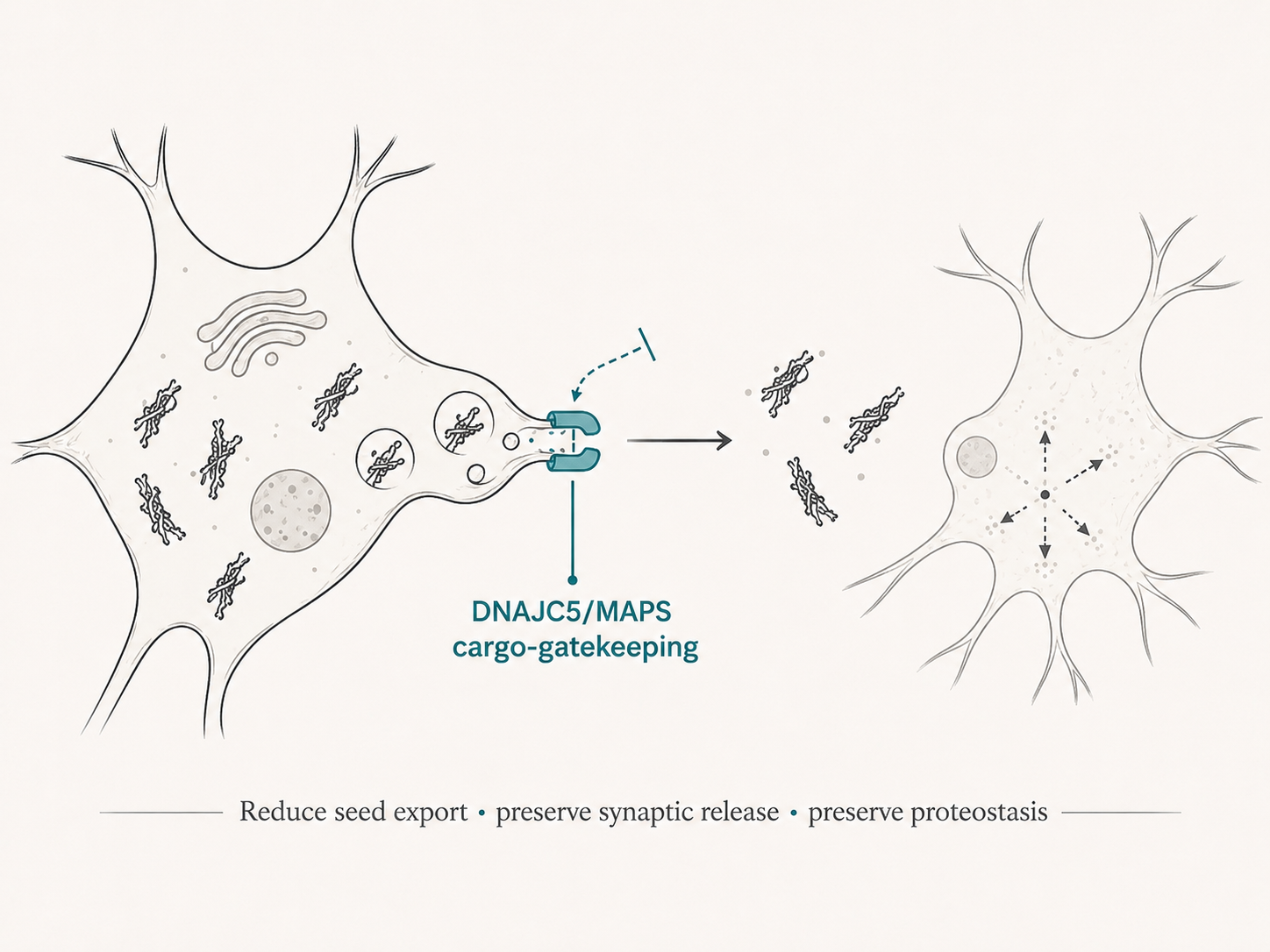
Working model
Misfolded 4R tau can become extracellular, seed-competent cargo. Lumenais Bio is testing whether DNAJC5/MAPS “cargo-gatekeeping” can reduce pathological tau entry into export pathways while monitoring normal synaptic release and cellular proteostasis in preclinical assay systems.
First indication
PSP as the first validation indication
A severe 4R tauopathy with no approved disease-modifying therapy. A focused preclinical indication for testing whether pathological tau export can be reduced in assay systems before broader proteinopathy expansion.
Mechanism layer
Cargo-gatekeeping
Misfolded tau can leave diseased neurons and seed healthy ones. The program tests whether the export step itself can be modulated selectively in preclinical models.
Target lane
DNAJC5/MAPS as first validation lane
The desired profile is selective cargo-gatekeeping, not DNAJC5 ablation or broad secretion shutdown. This is a testable first lane, not completed target validation.
Validation architecture
Four validation gates define the first build.
The first milestone is to prove whether pathological tau export can be reduced without suppressing normal synaptic release biology, collapsing secretion, or worsening intracellular proteostasis.
Primary signal
Seed-competent extracellular tau and downstream recipient-cell seeding activity decline.
Selectivity gate
The effect separates from synaptic silencing, generic secretion shutdown, or simple activity suppression.
Proteostasis gate
No intracellular tau-burden shifting, lysosomal stress, or DNAJC5 loss-of-function-like liability emerges.
Build decision
Advance, redirect, or kill before committing to modality scale-up or full drug-discovery spend.
What we need to see
Seed-competent tau export falls before or independently of synaptic decline.
Export remains reduced after normalization to synaptic release state.
Cells avoid intracellular tau burden, lysosomal stress, and loss-of-function-like liabilities.
Company thesis
PSP is the first validation context. Cargo-gatekeeping is the broader preclinical mechanism thesis.
If validated in assay systems, the same biology may inform broader age-related proteinopathies where proteostasis failure turns intracellular misfolded cargo into extracellular propagation risk.
12-month go/kill validation build
Build donor/recipient tau-export assays.
Test DNAJC5/MAPS perturbation and rescue.
Separate cargo-selective export reduction from synaptic release suppression.
Define causality, safety window, and translational markers before scale-up.
Extend to replication and translational-marker expansion if the 12-month gate is positive.
Boundary
Public materials are high-level and do not represent completed target validation, clinical utility, or medical guidance. The site intentionally avoids detailed rescue logic, unpublished numerical analyses, biomarker panels, and assay-enabling specifics; those are shared selectively through diligence.
Current posture: Hypothesis-forward, provisional IP filed, and organized around predefined advance, redirect, or stop criteria.
Origin: Developed at Lumenais Research through Deep Synthesis; translated into a PSP-first validation plan for Lumenais Bio.
Contact
Seeking partners for company building, assays, and venture creation.
Lumenais Bio is currently founder-led and preclinical. The next step is a focused validation build to establish causality, rescue logic, safety window, and translational markers before committing to modality scale-up.
Founder-led by Aaron Martinez, Lumenais Research / Lumenais Bio.